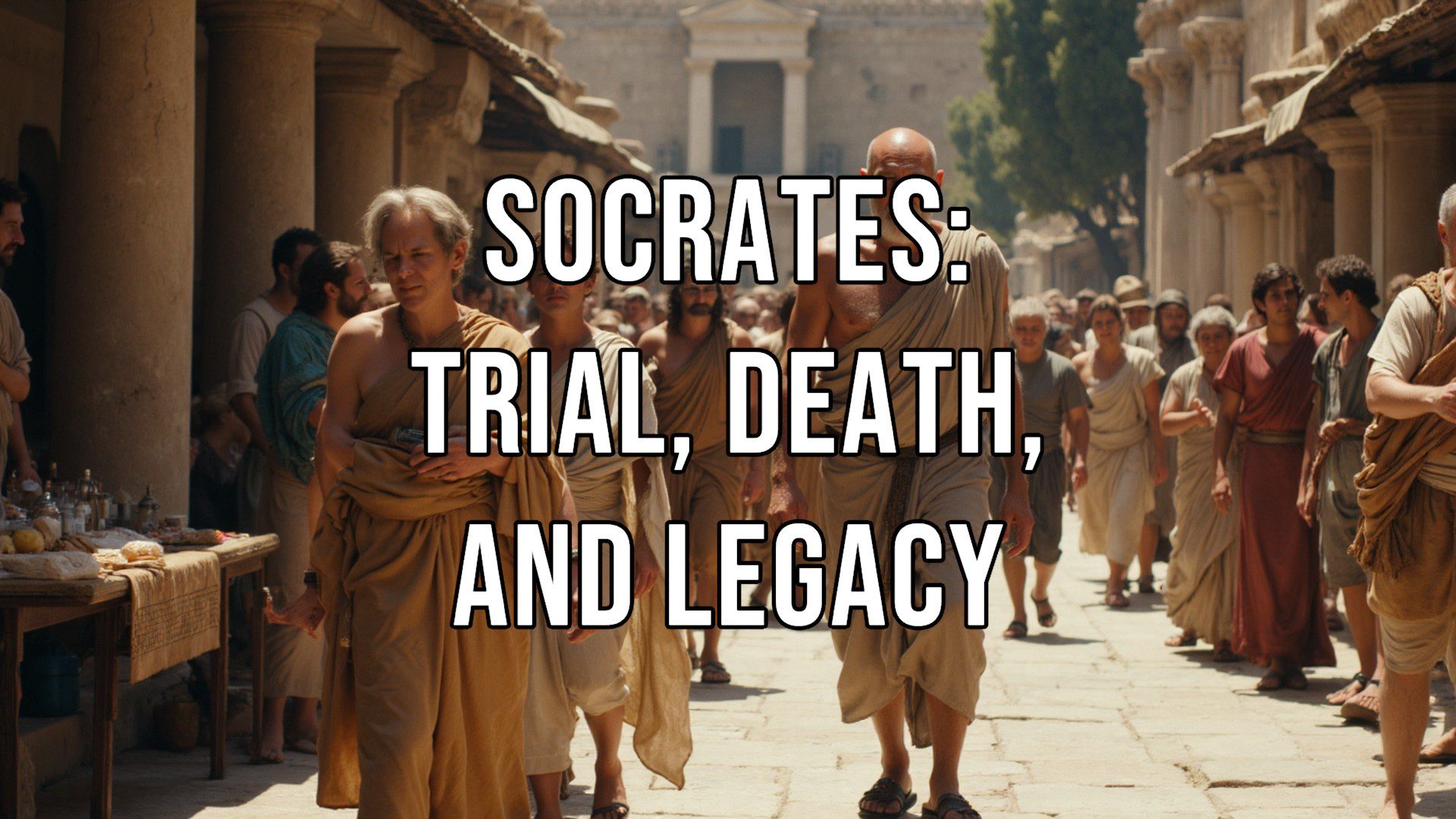
Few episodes in ancient history raise as many questions about free speech, civic duty, and the role of philosophy as the trial of Socrates in 399 BCE. Tried before an Athenian jury of citizens, the seventy-year-old philosopher was convicted of impiety and corrupting the youth and sentenced to death by hemlock. Was he a danger to democracy—or a gadfly whose questioning kept the city awake? This article walks through the political context, charges, courtroom drama, verdict, and legacy to show why Socrates’ trial still puts philosophy on trial today.
SEO Keywords: Trial of Socrates, Ancient Athens, Free Speech, Philosophy on Trial, Impiety, Corrupting the Youth, Hemlock, Athenian Democracy.
—
Athens After War: Setting the Stage
When Socrates stood before the jury, Athens was still reeling from the Peloponnesian War (431–404 BCE). The humiliation of defeat by Sparta, the brief terror of the Thirty Tyrants (404–403 BCE), and the fragile restoration of democracy left civic nerves raw. Elites were distrusted, and public opinion feared sophistry and anti-democratic ideas. Socrates, famous for cross-examining politicians, poets, and craftsmen, cut a controversial figure: admired by students, but resented by many who felt exposed by his questions.
SEO Keywords: Peloponnesian War, Thirty Tyrants, Athenian Democracy, Political Context, Ancient Greek History.
—
Who Was Socrates?
Socrates (469/470–399 BCE) never wrote a line. We know him through pupils and observers—most notably Plato and Xenophon. He practiced a method later called elenchus (refutation): asking short, probing questions to test definitions such as “What is courage?” or “What is justice?” He called himself a midwife of ideas, helping others give birth to understanding. He lived simply, walked barefoot, and claimed a divine inner sign, the daimonion, that warned him against certain actions. To admirers, he embodied integrity; to critics, he embarrassed powerful men and inspired restless youth.
SEO Keywords: Socratic Method, Elenchus, Daimonion, Plato, Xenophon, Ancient Philosophy.
—
The Indictment: What Was He Accused Of?
The formal charges were brought by Meletus (a poet), with the support of Anytus (an influential politician and tanner) and Lycon (an orator). The indictment alleged that Socrates:
1. Did not acknowledge the gods of the city,
2. Introduced new divine beings (daimonia), and
3. Corrupted the youth.
These accusations combined religious anxiety with political fear. Socrates’ association—real or perceived—with controversial figures such as Alcibiades and Critias (a leader among the Thirty) deepened suspicions that his questioning undermined civic loyalty.
SEO Keywords: Meletus, Anytus, Lycon, Impiety, Corrupting the Youth, Asebeia, Alcibiades, Critias.
—
How Athenian Trials Worked
Athens relied on large citizen juries (often 501 jurors for public suits). Jurors were chosen by lot using the kleroterion machine to reduce corruption. There were no lawyers; litigants spoke for themselves within strict time limits measured by a water clock (klepsydra). The trial had two phases:
Guilt phase: jurors voted guilty or not guilty.
Penalty phase: both sides proposed a penalty; the jury chose one.
SEO Keywords: Athenian Jury, Kleroterion, Klepsydra, Athenian Law, Greek Legal System.
—
Inside the Courtroom: Plato’s Apology
Our richest source for the defense is Plato’s Apology, which presents Socrates’ speech—not an apology in the modern sense, but a defense.
1) Dispelling Old Prejudices
Socrates distinguishes between old slanders (that he studies the heavens and makes the weaker argument stronger) and the present legal charges. He says he is no sophist for hire and never took fees.
2) The Divine Mission
He explains that the Oracle at Delphi once declared no one wiser than Socrates. Interpreting this as a riddle, he tested reputed experts and found they lacked self-knowledge. His mission, he claims, is to expose ignorance and encourage virtue—hence the gadfly metaphor: he stings the sluggish horse of the state to keep it alert.
3) Cross-Examining Meletus
Socrates questions Meletus: who improves the youth? If all Athenians except Socrates improve them, that’s absurd; if he corrupts them unintentionally, instruction—not punishment—is appropriate. He also argues that a man would not intentionally corrupt those who live with him, since harm would rebound upon himself.
4) Piety and the Daimonion
On impiety, Socrates notes that Meletus accuses him simultaneously of atheism and of introducing new divine beings. But if he believes in daimonia, he must believe in divine things—akin to believing in mules implies horses and donkeys. The charge, he suggests, is inconsistent.
SEO Keywords: Plato’s Apology, Delphi Oracle, Gadfly, Sophists, Cross-Examination, Daimonia, Athenian Religion.
—
Verdict and Penalty
Ancient accounts suggest a relatively narrow guilty vote (often reported around 280 to 221). In the penalty phase, the accusers sought death. Socrates ironically proposed that he deserved free meals at the Prytaneum (an honor for benefactors), then—at his friends’ urging—offered a fine of 30 minae, which Plato, Crito, Apollodorus and others promised to guarantee. The jury chose death. Socrates accepted the verdict, insisting that a good man cannot be harmed in the deepest sense.
SEO Keywords: Verdict, Prytaneum, 30 Minae, Hemlock, Crito, Apollodorus, Capital Punishment.
—
Why Did Athens Condemn Him?
Historians propose a cluster of reasons:
Postwar trauma: a city anxious for stability distrusts unsettling critics.
Political associations: former students implicated in anti-democratic acts stained Socrates by proximity.
Religious tension: unconventional talk of a daimonion and critiques of popular piety sounded like impiety.
Public style: relentless questioning humiliated respected citizens and fueled hostility.
Populist dynamics: large juries could be swayed by rhetoric and fear more than by abstract principle.
SEO Keywords: Political Anxiety, Religious Conservatism, Populism, Athenian Public Opinion.
—
Refusing Escape: Crito and the Rule of Law
In Plato’s Crito, Socrates’ wealthy friend Crito urges him to escape. Socrates refuses, arguing that to break the laws would injure the city and contradict his lifelong commitment to justice. He personifies the Laws of Athens: he has benefited from them and remained in the city freely; to flee now would be an unjust retaliation. He chooses to obey the law, even when it kills him.
SEO Keywords: Crito, Civil Obedience, Rule of Law, Athenian Laws, Philosophical Integrity.
—
The Death Scene: Phaedo
Plato’s Phaedo portrays Socrates’ final hours discussing the immortality of the soul. Surrounded by companions, he drinks the hemlock calmly, reminding them to sacrifice a cock to Asclepius—a cryptic sign that death may be a cure for the disease of life. Whatever the historical accuracy, the scene fixed Socrates as philosophy’s martyr.
SEO Keywords: Phaedo, Immortality of the Soul, Asclepius, Death by Hemlock, Philosophical Martyrdom.
—
Sources and Reliability: Plato vs. Xenophon
Our two main literary witnesses disagree in tone. Plato presents a fearless, ironic critic of public ignorance; Xenophon offers a more conservative, pious Socrates. Neither is a courtroom transcript; both are crafted works with philosophical agendas. Yet independent points converge: Socrates admitted a divine sign, took no fees, challenged convention, and accepted death rather than betray his principles.
SEO Keywords: Plato vs Xenophon, Historical Sources, Reliability, Ancient Biography.
—
What Was Really on Trial?
More than a man stood in judgment. The jury weighed competing visions of citizenship:
Is a good citizen the one who conforms to civic ritual—or the one who questions public assumptions to improve the city?
Does piety mean honoring traditional gods—or seeking a deeper, rational account of the good?
Can democracy tolerate relentless criticism without losing confidence?
Socrates insisted that virtue (arete) and examination are the core of human flourishing: “the unexamined life is not worth living.”
SEO Keywords: Citizenship, Piety, Virtue, Arete, Democratic Critique, Unexamined Life.
—
Legacy: Why the Trial Still Matters
Birth of Western ethics: Socrates’ commitment to reason over popularity shaped Plato, Aristotle, and the entire tradition of moral philosophy.
Model of conscience: He embodies the tension between individual conscience and state authority, a theme echoed in later thinkers and legal debates.
Free speech and academic freedom: His death warns democracies against equating dissent with disloyalty.
Education by questioning: The Socratic method remains central to law schools and classrooms worldwide.
SEO Keywords: Moral Philosophy, Academic Freedom, Freedom of Speech, Conscience vs State, Socratic Method in Education.
—
Common Misconceptions (Quick Debunks)
Socrates was a sophist. → No; sophists charged fees and taught rhetoric for advantage. Socrates claimed he did not teach, only questioned, and took no payment.
He was executed for atheism. → The charge was impiety and introducing new divine things; he explicitly claimed a divine sign.
He could have chosen exile. → In the Athenian system, the jury chooses between proposed penalties; Socrates refused to propose exile and instead offered a fine, which the jury rejected.
The trial was purely religious. → Politics and postwar trauma were inseparable from religion in Athens; the case was civic-religious.
SEO Keywords: Sophists vs Socrates, Atheism vs Impiety, Exile Option, Civic Religion.
—
Timeline (Key Dates)
469/470 BCE: Birth of Socrates in Athens.
431–404 BCE: Peloponnesian War.
404–403 BCE: Thirty Tyrants; democracy restored.
399 BCE: Trial, conviction, and death of Socrates.
4th century BCE onward: Plato’s Academy; Socratic legacy shapes Western thought.
—
Conclusion: Philosophy on Trial
The trial of Socrates crystallizes a permanent dilemma: how can a community both preserve itself and welcome relentless questioning? Athens chose security over challenge and executed its most probing citizen. Yet in doing so, it multiplied his influence. From the Apology to modern classrooms, Socrates’ questions keep stinging us awake. Democracies need gadflies—not to destroy faith in the city, but to refine it through reasoned critique.
Final SEO Keywords: Trial of Socrates, Philosophy on Trial, Ancient Athens, Impiety Charge, Corrupting the Youth, Plato’s Apology, Hemlock Death, Free Speech, Socratic Method, Western Philosophy.
The Trial of Socrates | Philosophy on Trial
Few episodes in ancient history raise as many questions about free speech, civic duty, and the role of philosophy as the trial of Socrates in 399 BCE. Tried before an Athenian jury of citizens, the seventy-year-old philosopher was convicted of impiety and corrupting the youth and sentenced to death by hemlock. Was he a danger…
7–10 minutes
Ancient Athens, Ancient Greek History, Athenian Democracy, Corrupting the Youth, Crito, Daimonion, Elenchus, Free Speech, Gadfly of Athens, Hemlock Death, Impiety, Oracle of Delphi, Peloponnesian War, Phaedo, Philosophy on Trial, Plato’s Apology, Socratic Method, Thirty Tyrants, Trial of Socrates, Western Philosophy




Leave a Reply