Few periods in history shine as brightly as the Golden Age of Athens. Lasting roughly from the early 5th century BCE to the late 4th century BCE, this era transformed Athens into the cultural, political, and intellectual heart of the ancient world. Under the leadership of statesmen like Pericles, Athens became synonymous with democracy, philosophy, drama, architecture, and art.
The achievements of this Golden Age were not limited to Greece. They laid the foundations for Western civilization, influencing politics, education, literature, science, and culture for millennia to come.
SEO Keywords: Athens Golden Age, Ancient Greece, Pericles, Athenian democracy, Greek philosophy, Greek drama, Parthenon, Western civilization.
—
The Historical Context
The Golden Age of Athens followed the city’s victory in the Persian Wars (490–479 BCE). The triumphs at Marathon, Salamis, and Plataea gave Athens prestige and the confidence to lead the Delian League, an alliance of Greek city-states. Wealth from this alliance flowed into Athens, funding its grand cultural projects.
At the same time, Athens developed a system of direct democracy, giving citizens the right to vote and participate in government. This political system was revolutionary for its time, even though it excluded women, slaves, and foreigners.
SEO Keywords: Persian Wars, Marathon, Salamis, Plataea, Delian League, Athenian democracy, Ancient Greek politics.
—
Pericles and the Athenian Vision
The most prominent leader of Athens’ Golden Age was Pericles (c. 495–429 BCE). He championed democracy, promoted the arts, and oversaw massive building projects. His vision turned Athens into a cultural and intellectual capital.
Pericles used Delian League funds to rebuild the Acropolis, commissioning masterpieces such as the Parthenon, the Propylaea, and the Temple of Athena Nike. He also supported festivals, theater, and education, ensuring that the arts flourished alongside politics.
SEO Keywords: Pericles, Acropolis, Parthenon, Temple of Athena Nike, Athenian leadership, Golden Age architecture.
—
Democracy in Action
Athens’ democracy was a bold experiment in citizen participation. Unlike representative systems, Athenian democracy was direct—citizens themselves debated and voted on laws. Important institutions included:
The Assembly (Ekklesia): The main decision-making body where citizens debated policies.
The Council of 500 (Boule): Managed daily affairs and prepared issues for the Assembly.
People’s Courts (Dikasteria): Large juries of citizens decided trials, reinforcing the idea of civic responsibility.
Though imperfect by modern standards, Athens pioneered concepts of accountability, equality before the law, and civic participation.
SEO Keywords: Athenian democracy, Ekklesia, Boule, Dikasteria, citizen participation, direct democracy.
—
Philosophy and Intellectual Life
The Golden Age saw the rise of Greek philosophy, which continues to shape thought today.
Socrates challenged Athenians to examine their beliefs, using dialogue and questioning.
Plato, his student, founded the Academy, exploring justice, truth, and the ideal state.
Aristotle, Plato’s student, established the Lyceum, contributing to science, ethics, and politics.
Athens became the intellectual crossroads of the ancient world, where philosophy, science, and debate flourished.
SEO Keywords: Socrates, Plato, Aristotle, Greek philosophy, Academy, Lyceum, Ancient Greek thought.
—
Drama and Theater
Theater was central to Athenian culture. Plays were performed during religious festivals such as the Dionysia, combining entertainment with civic education.
Tragedy: Playwrights like Aeschylus, Sophocles, and Euripides explored fate, justice, and human suffering.
Comedy: Aristophanes used humor to satirize politics and society.
These works are still performed today, a testament to their enduring themes and artistic brilliance.
SEO Keywords: Aeschylus, Sophocles, Euripides, Aristophanes, Greek tragedy, Greek comedy, Ancient theater, Dionysia.
—
Architecture and Art
Athens’ Golden Age produced architectural marvels that symbolized harmony, proportion, and beauty. The Parthenon, dedicated to Athena, remains one of the most iconic buildings in history. Its use of the Doric order, mathematical precision, and sculptural decoration reflected Athenian ideals.
Sculptors like Phidias created lifelike statues, combining realism with ideal beauty. Public buildings, temples, and theaters showcased Athens as the cultural capital of the Mediterranean.
SEO Keywords: Parthenon, Phidias, Greek architecture, Doric order, Acropolis, Ancient Greek art.
—
Science, Mathematics, and History
Athens also advanced knowledge in multiple fields:
Hippocrates revolutionized medicine with his emphasis on natural causes of disease.
Herodotus and Thucydides pioneered historical writing, focusing on causes and analysis rather than myth.
Euclid and other mathematicians laid foundations for geometry.
These achievements reflect the Athenian spirit of inquiry, blending observation with rational explanation.
SEO Keywords: Hippocrates, Herodotus, Thucydides, Euclid, Greek science, Ancient medicine, history writing.
—
The Peloponnesian War: Decline of the Golden Age
Athens’ Golden Age did not last forever. Rivalry with Sparta led to the Peloponnesian War (431–404 BCE). Despite Pericles’ leadership, Athens suffered devastating losses, including the plague of 430 BCE, military defeats, and eventual surrender.
The war weakened Athens, though its cultural achievements continued to inspire future generations. Even in decline, the legacy of the Golden Age endured.
SEO Keywords: Peloponnesian War, Sparta, Athenian decline, plague of 430 BCE, Ancient Greek wars.
—
Legacy of Athens’ Golden Age
The Golden Age of Athens shaped the future of Western civilization. Its contributions to democracy, philosophy, drama, architecture, and science remain central to modern culture. From the U.S. Constitution to Renaissance art, the influence of Athens is everywhere.
Athens’ Golden Age was more than a historical moment—it was a blueprint for cultural and intellectual innovation that continues to inspire humanity.
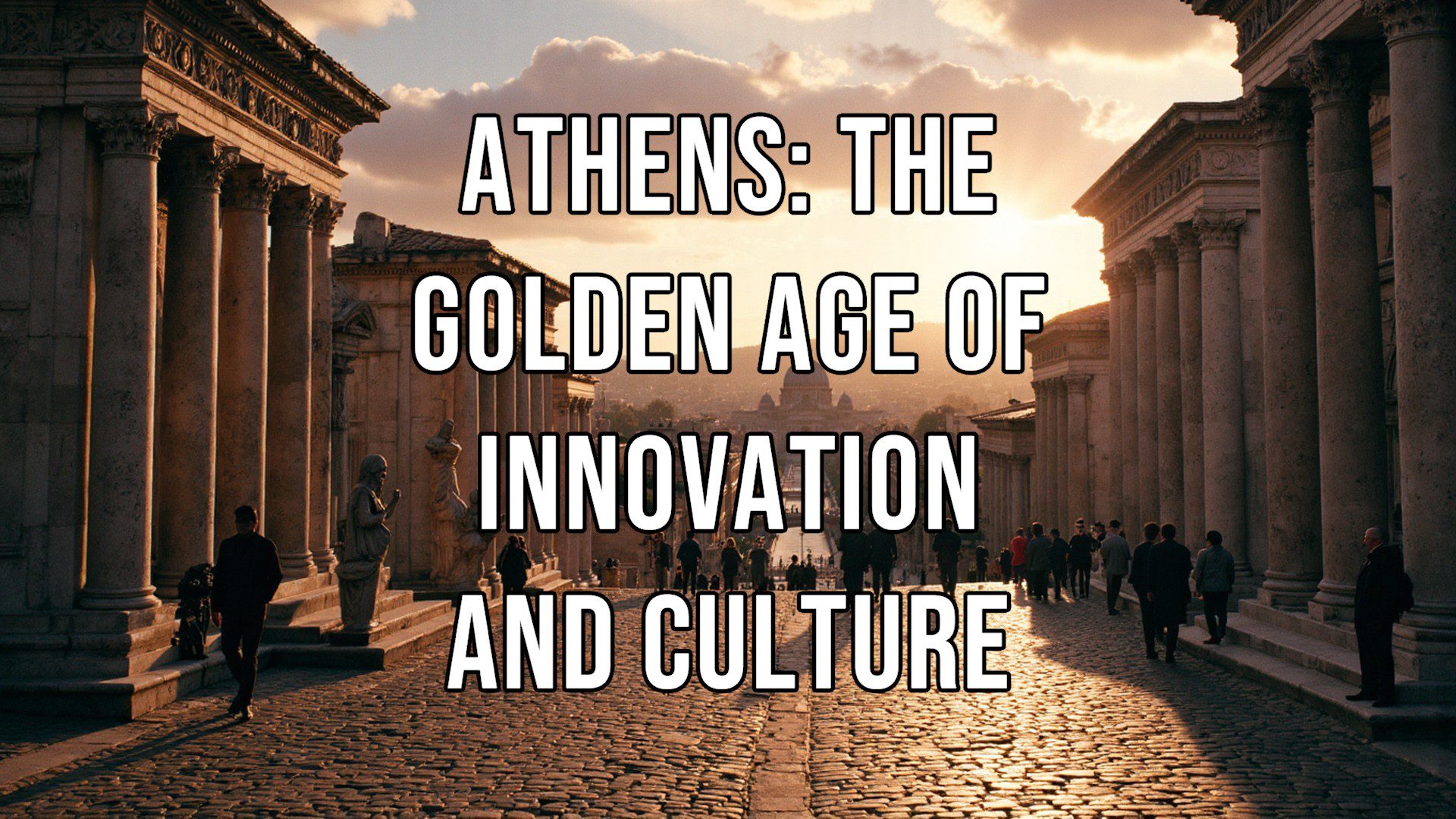
Athens: The Golden Age of Innovation and Culture
Discover Athens’ Golden Age, a time of democracy, philosophy, drama, and art. Learn how Pericles, the Parthenon, and Greek thinkers shaped Western civilization.




Leave a Reply