The British Empire was the largest empire in history, spanning every continent and ruling over nearly a quarter of the world’s population at its height. From the 16th century to the 20th century, Britain built an empire based on exploration, trade, colonization, and military conquest.
The story of the empire is one of innovation, ambition, exploitation, and resistance. It profoundly shaped global politics, economics, culture, and identity, leaving a legacy that continues to influence the modern world.
SEO Keywords: British Empire, rise and fall, world’s largest empire, colonialism, imperial history, Great Britain, global power.
—
The Early Foundations
The roots of the British Empire can be traced to the Age of Exploration in the late 15th and 16th centuries. Inspired by Spain and Portugal, English explorers like John Cabot and Sir Francis Drake ventured across the Atlantic.
The founding of colonies in North America (Jamestown, 1607) and the establishment of the East India Company (1600) marked the beginning of Britain’s global ambitions.
SEO Keywords: Age of Exploration, John Cabot, Francis Drake, Jamestown colony, East India Company, early British colonization.
—
Expansion in the Americas
By the 17th and 18th centuries, Britain had established thriving colonies in the Caribbean and North America. Sugar plantations fueled immense wealth, while the transatlantic slave trade brought millions of Africans to work in brutal conditions.
The loss of the Thirteen Colonies after the American Revolution (1775–1783) was a major blow, but Britain shifted focus to other parts of the world, particularly India and Africa.
SEO Keywords: American colonies, Caribbean plantations, transatlantic slave trade, American Revolution, loss of colonies.
—
India: The Jewel in the Crown
India became the centerpiece of the British Empire. Through the East India Company, Britain gained control of vast territories after the Battle of Plassey (1757). Following the Indian Rebellion of 1857, India came under direct crown rule as the British Raj.
Railways, legal systems, and education were introduced, but India also suffered from economic exploitation and famine. Indian nationalism grew, culminating in independence in 1947 under leaders like Mahatma Gandhi and Jawaharlal Nehru.
SEO Keywords: British Raj, East India Company, Battle of Plassey, Indian Rebellion 1857, Mahatma Gandhi, Indian independence.
—
Africa and the Scramble for Colonies
The Scramble for Africa in the late 19th century saw Britain expand its empire into Egypt, Sudan, South Africa, and beyond. The construction of the Suez Canal (1869) gave Britain vital control over trade routes to India and Asia.
Conflicts like the Boer Wars highlighted tensions, while African resistance movements challenged colonial domination.
SEO Keywords: Scramble for Africa, Suez Canal, Boer Wars, British Africa, colonial resistance, South Africa.
—
Pax Britannica: Global Power
From 1815 to 1914, Britain enjoyed relative dominance in global affairs, a period known as Pax Britannica. With the world’s most powerful navy, Britain controlled key sea routes and global trade.
London became the financial capital of the world, and British inventions fueled the Industrial Revolution, further strengthening imperial power.
SEO Keywords: Pax Britannica, British Navy, Industrial Revolution, global trade, London finance, 19th century empire.
—
Culture and Language
One of the lasting impacts of the British Empire is cultural. English became the global language of diplomacy, trade, and education. British legal systems, parliamentary democracy, and institutions spread worldwide.
At the same time, colonial subjects influenced Britain, bringing food, music, art, and traditions that reshaped British identity.
SEO Keywords: English language, British culture, parliamentary democracy, colonial influence, global education, cultural exchange.
—
Decline of the Empire
The two World Wars dealt heavy blows to the empire. World War I drained resources, while World War II accelerated decolonization. The rise of the United States and the Soviet Union as superpowers overshadowed Britain’s influence.
Decolonization swept across Asia, Africa, and the Caribbean after 1945. Landmark moments included Indian independence (1947), African liberation movements (1950s–1970s), and the transfer of Hong Kong to China in 1997.
SEO Keywords: World War I, World War II, decolonization, Indian independence 1947, African liberation, Hong Kong 1997, decline of empire.
—
Legacy of the British Empire
The empire left a complex and controversial legacy:
Positive legacies: English language, railways, legal frameworks, global trade networks.
Negative legacies: Slavery, economic exploitation, cultural erasure, racial hierarchies, and unresolved conflicts.
The Commonwealth of Nations remains a reminder of Britain’s global ties, though its role is largely symbolic.
SEO Keywords: legacy of British Empire, slavery, Commonwealth of Nations, colonial impact, global trade, cultural legacy.
—
Conclusion
The rise and fall of the British Empire is a story of ambition, conquest, and transformation. At its peak, it shaped nearly every corner of the world. Its decline reshaped the 20th century, giving birth to new nations and new global powers.
Today, the legacy of the British Empire is debated: was it a force for progress or oppression? In truth, it was both—a reminder of the power and consequences of empire in world history.
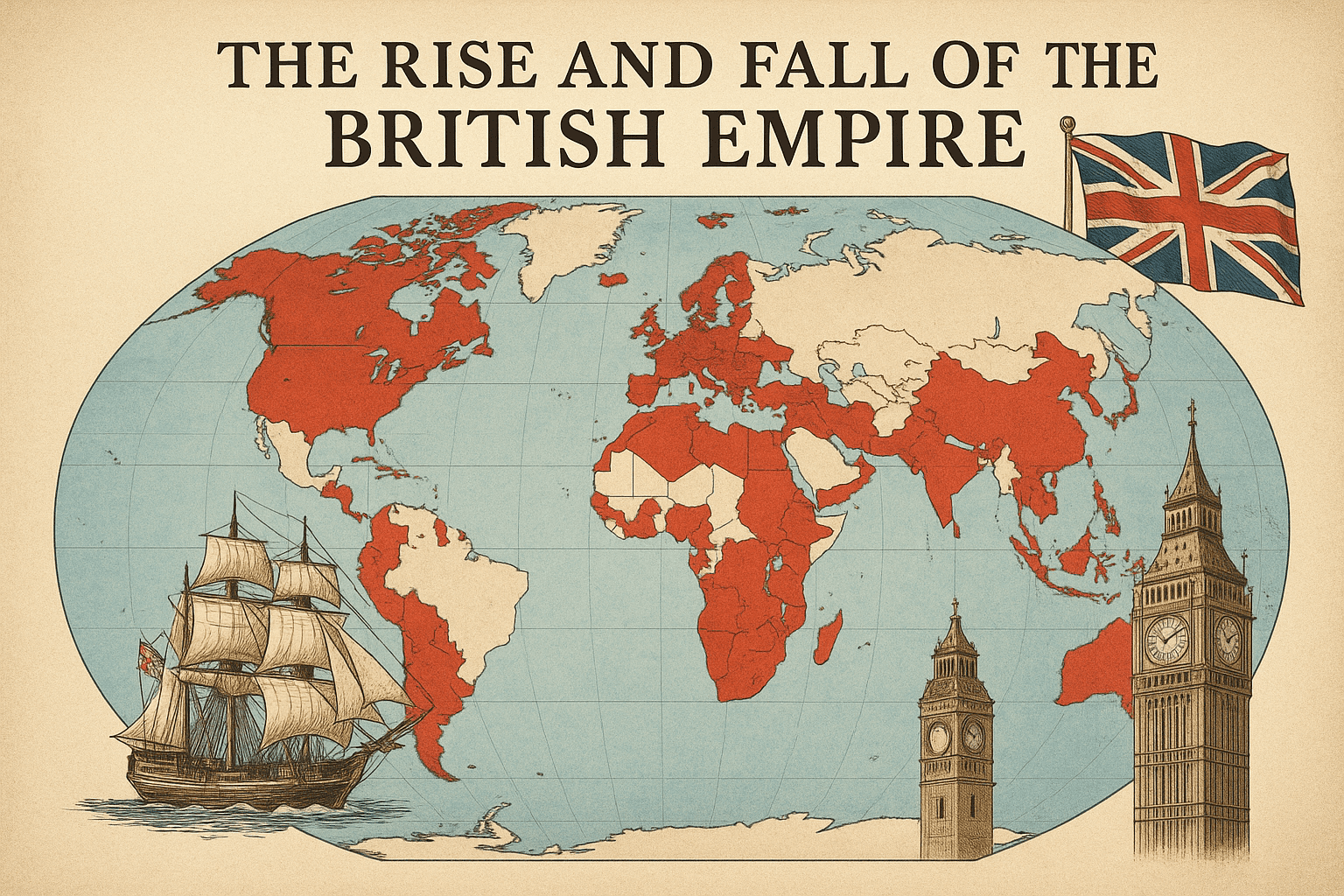
The Rise and Fall of the British Empire: The World’s Largest Empire
The British Empire rose to dominate the globe, ruling a quarter of the world’s population. Discover its rise, golden age, decline, and lasting legacy.
3–5 minutes
Boer Wars, British Empire, British Raj, colonial legacy, colonialism, Commonwealth of Nations, decolonization, East India Company, English language, Hong Kong 1997, Indian independence, Industrial Revolution, London finance, Pax Britannica, rise and fall, Scramble for Africa, Suez Canal, World History, World War I, World War II



Leave a Reply