The invasion of Russia in 1812 stands as one of the most dramatic and catastrophic campaigns in military history. Launched by Napoleon Bonaparte, Emperor of the French, it was intended to force Tsar Alexander I of Russia back into alliance with France and enforce the Continental System, Napoleon’s economic blockade against Britain.
Instead, the campaign became a disaster of unimaginable scale. Napoleon’s mighty Grande Armée, one of the largest forces ever assembled in Europe, marched deep into Russian territory, capturing Moscow. But a combination of Russian tactics, logistical failures, and the brutal Russian winter decimated his army.
This article explores the causes, course, and consequences of the 1812 invasion, examining why Napoleon’s most ambitious gamble ended in catastrophe and reshaped European geopolitics.
SEO Keywords: Napoleon invasion of Russia, 1812 campaign, Grand Army, Russian winter, Battle of Borodino, retreat from Moscow.
—
Background: The Napoleonic Wars and the Continental System
By the early 19th century, Napoleon had established dominance over much of continental Europe. Through conquest and alliances, France controlled or influenced Spain, Italy, the Netherlands, much of Germany, and Poland. Only Britain remained beyond his reach.
To weaken Britain, Napoleon imposed the Continental System (1806), banning European nations from trading with British merchants. Russia, initially an ally after the Treaty of Tilsit (1807), grew resentful of this policy. The blockade harmed Russia’s economy, cutting off vital imports and reducing exports. By 1810, Tsar Alexander I openly defied Napoleon, reopening trade with Britain.
This defiance infuriated Napoleon. To preserve his system of European hegemony, he resolved to invade Russia and bring it to heel.
SEO Keywords: Continental System, Treaty of Tilsit, Napoleonic Wars, Tsar Alexander I, Britain blockade.
—
The Grande Armée: Napoleon’s Colossus
Napoleon assembled the Grande Armée, the largest force he had ever commanded. Numbering over 600,000 men, it included soldiers from across the French Empire and allied states:
French, Poles, Italians, Germans, Dutch, and even reluctant allies like Austrians and Prussians.
1,200 cannons, massive supply trains, and cavalry numbering more than 90,000.
On paper, the army was unstoppable. But its multinational character bred tensions, and its sheer size posed logistical nightmares. Supplying such a force across the vast expanses of Russia would prove impossible.
SEO Keywords: Grande Armée size, Napoleon army 1812, multinational troops, Napoleonic logistics.
—
The Invasion Begins (June 1812)
On 24 June 1812, Napoleon crossed the Niemen River into Russian territory. Expecting a decisive battle, he planned to crush the Russian armies swiftly. But the Russians under Generals Barclay de Tolly and Bagration adopted a strategy of retreat, avoiding major engagements while drawing Napoleon deeper into Russia.
This scorched earth policy devastated the countryside. Villages were burned, crops destroyed, and wells poisoned, leaving the Grande Armée starving in a barren land.
SEO Keywords: Niemen River crossing, Barclay de Tolly, Bagration, scorched earth Russia, Napoleon advance.
—
The Battle of Smolensk (August 1812)
In August, Napoleon captured Smolensk after heavy fighting. The Russians, however, again withdrew, denying Napoleon the decisive victory he craved. The city’s destruction offered little in terms of supplies or shelter.
Frustrated, Napoleon pressed on toward Moscow, believing its capture would end the war.
SEO Keywords: Battle of Smolensk, Napoleon frustration, Russian retreat, Moscow objective.
—
The Battle of Borodino (7 September 1812)
The largest and bloodiest battle of the campaign came at Borodino, about 70 miles west of Moscow. The Russians, now under General Kutuzov, chose to make a stand.
Over 250,000 troops clashed in a day-long slugfest.
Casualties were enormous: around 30,000 French and 45,000 Russians killed or wounded.
Despite holding the field, Napoleon failed to destroy the Russian army.
Borodino was a pyrrhic victory—Napoleon won the ground but lost the campaign’s momentum.
SEO Keywords: Battle of Borodino, Kutuzov, Napoleonic bloodbath, pyrrhic victory, 1812 campaign.
—
The Capture of Moscow (September 1812)
On 14 September 1812, Napoleon entered Moscow. But instead of negotiating peace, the French found the city largely deserted—and soon engulfed in flames. Fires, likely set by Russian patriots, destroyed most of the city.
Napoleon waited in vain for Tsar Alexander I to sue for peace. Weeks passed, but no offer came. With winter approaching, supplies dwindling, and morale collapsing, Napoleon faced a fateful choice.
SEO Keywords: Napoleon in Moscow, Moscow fire 1812, Tsar Alexander defiance, empty victory.
—
The Retreat from Moscow (October–December 1812)
On 19 October, Napoleon ordered a retreat. What followed was one of the most harrowing marches in military history.
Starvation and Cold: Temperatures plunged below -20°C. Horses died by the thousands; men froze or starved.
Russian Attacks: Cossack cavalry and partisan fighters harassed the retreating columns.
Crossing the Berezina (November 1812): Thousands perished as the army struggled to cross the icy river under Russian fire.
By the time the shattered remnants staggered back across the Niemen in December, fewer than 100,000 men remained of the original 600,000.
SEO Keywords: Retreat from Moscow, Russian winter, Cossack attacks, Berezina crossing, Napoleonic disaster.
—
Reasons for Failure
Historians identify several causes for Napoleon’s disaster:
1. Logistics: Inadequate supplies for such a massive force.
2. Russian Strategy: Retreat, scorched earth, and refusal to fight decisive battles.
3. Climate: The brutal Russian winter compounded exhaustion and hunger.
4. Overextension: Napoleon misjudged distances and underestimated Russia’s size.
5. Morale: Multinational troops lacked cohesion and deserted in large numbers.
SEO Keywords: Napoleon failure Russia, logistics collapse, scorched earth strategy, Russian winter myth.
—
Consequences of the 1812 Campaign
The invasion of Russia shattered Napoleon’s aura of invincibility:
Political Impact: European powers saw France’s weakness and rallied against it.
Military Impact: France lost the bulk of its veteran army.
Geopolitical Impact: The 1812 disaster paved the way for the War of the Sixth Coalition, Napoleon’s defeat in 1814, and his eventual downfall.
For Russia, the victory became a cornerstone of national pride, remembered as the Patriotic War of 1812.
SEO Keywords: consequences 1812 campaign, War of the Sixth Coalition, Patriotic War Russia, Napoleon downfall.
—
Legacy of the Invasion
The campaign of 1812 has entered legend as the archetypal military disaster. It has been studied for lessons in strategy, logistics, and hubris. The image of the Grande Armée perishing in the snow remains one of the defining symbols of the Napoleonic era.
Writers like Leo Tolstoy immortalized it in War and Peace.
Military academies teach it as a cautionary tale.
In Russian memory, it is celebrated as a triumph of endurance and patriotism.
SEO Keywords: legacy 1812 invasion, Tolstoy War and Peace, Napoleonic studies, military disaster lessons.
—
Conclusion
Napoleon’s invasion of Russia in 1812 was his greatest gamble—and his greatest failure. What began as an attempt to enforce his dominance over Europe ended in catastrophe, with hundreds of thousands dead and the French Empire fatally weakened.
The campaign reshaped Europe, paving the way for Napoleon’s downfall and a new balance of power. It remains one of the most dramatic reminders of how ambition, logistics, and nature can combine to undo even the mightiest of armies.
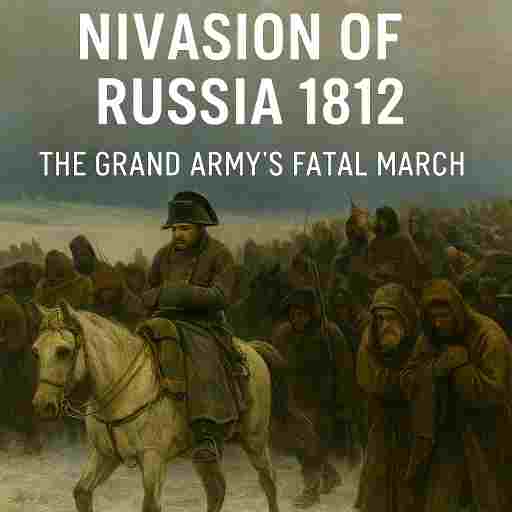
Napoleon’s Invasion of Russia 1812 | The Grand Army’s Fatal March
Napoleon’s 1812 invasion of Russia was a colossal disaster. From Borodino to the retreat from Moscow, discover how the Grand Army was destroyed and Europe reshaped.




Leave a Reply